Why
I. Why Study the Atmosphere
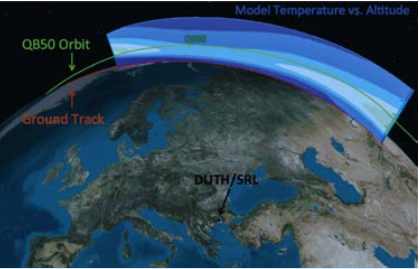
QB50 is an innovative concept that is based entirely on CubeSats: It is a project funded by the European Commission through an FP7 grant, targeting to launch a network of 50 CubeSats in Low Earth Orbit (LEO), in order to study the Earth’s Lower Thermosphere. Through QB50, universities worldwide were invited to submit proposals for their Cube- Sat design and implementation in a highly competitive call. Out of the numerous submitted proposals, 50 universities were invited to join the project and send a satellite to space. All 50 CubeSats will be launched together on a single launch vehicle, with launch currently planned for 1/2/2016. Each team is responsible to build their own spacecraft, securing their own funds, and is also expected to downlink its satellite’s data and uplink commands with its own ground station, while networks of ground stations are also envisioned and encouraged, in order to enhance coverage, satellite tracking and data volumes. By the time of launch it is expected that many of the QB50 ground stations in different parts of the world will be collaborating, linking their ground stations and providing nearly continuous uplink and downlink capability for all QB50 CubeSats, but also for other future missions.
II. Upper Atmosphere ElectroDynamics Modelling
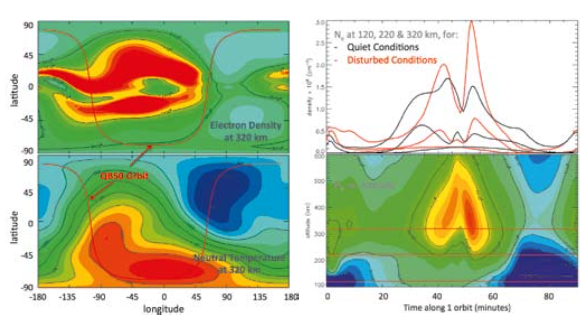
DUTH/SRL has extensive expertise in modelling and data analysis in the Mesosphere-Lower Thermosphere-Ionosphere (MLTI); DUTH/SRL has undertaken and has recently successfully completed an ESA project titled “Electrodynamics Simulations in support to Future MLTI Missions”, aiming to investigate the range of variability of key variables in the MLTI. Through this project a number of key MLTI models were run for a range of input conditions (solar, geomagnetic, seasonal) and the results from the models were intercompared and also compared against measurements. The models and corresponding variables investigated are listed below:
- • TIE-GCM(Tn,Ti,Te,U,W,O,O2,NO, N(4S),N(2D),O+,O2+,N2+,NO+,N+,Ne,G-Potential,E-Pot)
- • GUMICS-4 (N,P,U,T,MF,EF,ΣPedersen,ΣHall, E-Potential, PP power, Joule heating, FAC)
- • IRI-07 (Ne, Te, Ti, H+, He+, NO+, O+,O2+, ion drifts, TEC, F1 and spread-F-probability)
- • NRLMSISE-00 (Tn, He, O, O2, N2,Ar, H, N, Density, collision frequency)
- • CHAMP Currents Model (Horizontal and Field Aligned Currents)
- • Alpha parameter Model (Pedersen/Hall conductivity ratio)
- • HWM-07 (Zonal and Meridional winds )
In the list above we mark in red the MLTI variables that will be sampled by the QB50 CubeSats. The analysis performed at DUTH/SRL will allow for the optimal calibration of the QB50 Science Units and will play a key role in the data analysis, through comparisons of the measurements of all 50 QB50 sensors with current state-of-the-art models.
III. Educational Aspects of the QB50 CubeSat Initiative
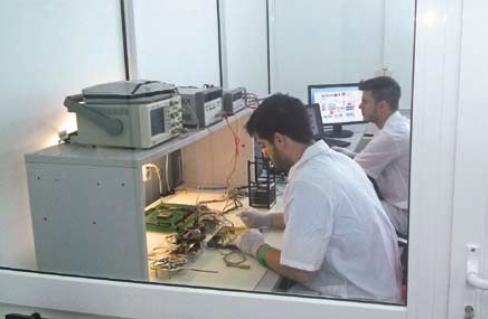
Together with its scientific impact, the QB50 initiative has an important educational aspect: the QB50 CubeSats are being designed and built by a large number of young engineers, supervised by experienced university staff and guided by the QB50 project through formal reviews and feedback. At the same time, space mission analysis and design procedures and standards are followed, introducing in the optimal way young engineers in a broad variety of aspects of space projects.
These engineers will not only learn about space engineering in theory but will leave their universities with handson experience. At the Democritus University of Thrace, the design and construction of the satellite is accompanied by a series of classes on Space Systems, Space Applications and Space Electrodynamics; furthermore, multiple undergraduate and graduate diploma theses are focused on Satellite Subsystems. The students that participate in this project have a unique opportunity to follow all phases of a space mission, from design to spacecraft development, integration with instruments, testing, launch, tracking and finally to receiving and analysing valuable scientific data.