About
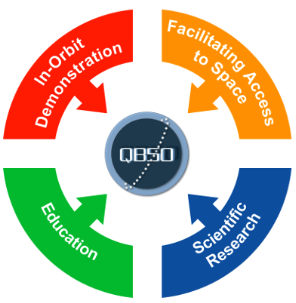
QB50 Initiative
QB50 is an innovative concept that is based entirely on CubeSats: It is a project funded by the European Commission through an FP7 grant, targeting to launch a network of 50 CubeSats in Low Earth Orbit (LEO), in order to study the Earth’s Lower Thermosphere. Through QB50, universities worldwide were invited to submit proposals for their Cube- Sat design and implementation in a highly competitive call. Out of the numerous submitted proposals, 50 universities were invited to join the project and send a satellite to space. All 50 CubeSats will be launched together on a single launch vehicle, with launch currently planned for 1/2/2016. Each team is responsible to build their own spacecraft, securing their own funds, and is also expected to downlink its satellite’s data and uplink commands with its own ground station, while networks of ground stations are also envisioned and encouraged, in order to enhance coverage, satellite tracking and data volumes. By the time of launch it is expected that many of the QB50 ground stations in different parts of the world will be collaborating, linking their ground stations and providing nearly continuous uplink and downlink capability for all QB50 CubeSats, but also for other future missions.
The target of all satellites will be to study in-situ the temporal and spatial variability of a number of key constituents and upper atmosphere environmental parameters. The CubeSats will be launched from the same launch vehicle at an initial altitude of ~400 km with an inclination of 98 deg. Due to atmospheric drag, the satellites will gradually decelerate, spiraling down to the lower layers of the upper atmosphere. This will enable obtaining measurements throughout the entire Mesosphere – Lower Thermosphere and Ionosphere (MLTI) region, which, as described below, is a great step forward in MLTI research. When the satellites reach the lower and denser layers, the large temperatures that will develop due to enhanced friction will eventually lead to loss of satellite functionality and subsequently to melting and the loss of surface material from the spacecraft by evaporation. This is expected to occur in the Mesosphere, at altitudes between 80 and 100 km, where all meteorites ablate due to friction with the atmosphere.
DUTH/SLR
The Laboratory of Electromagnetism and Space Research of the Democritus University of Thrace (DUTH/SRL) has been selected to join the QB50 European initiative for the launch of 50 nano-satellites in the upper atmosphere by January 2016.
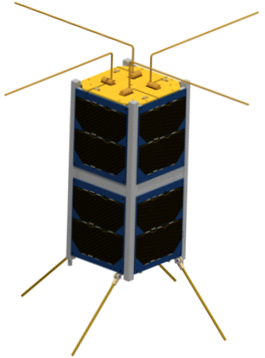
The aim is to investigate with multi-point measurements the transition region between the atmosphere and space. The 50 nano-satellites follow the CubeSat standard, where a CubeSat is a modular satellite of standardized dimensions, assembled using primarily commercial, off-the shelf components.
This provides an excellent opportunity for the launch of a Greek miniaturized satellite that is entirely built by University students and engineers. Through the QB50 program a launch opportunity and part of the science payload are provided whereas the development of each CubeSat and the ground station for communications and operations are built by the host institution.
GREEK PARTICIPATION INITIATIVE
The Department of Electrical and Computer Engineering of the Democritus University of Thrace has a long-term involvement in space science and technology. It submitted a proposal to join the QB50 team in 2012, and currently DUTH is officially listed as one of the participating universities (https://www.qb50.eu/index.php/community). Participation in the QB50 consortium provides the science sensors and coordination of the project, whereas each participant of QB50 needs to design and develop their own CubeSat, securing funding through institutional or national funds.
In addition, each team needs to contribute towards launch costs.
For DUTHSat funding for the development of the satellite was secured through a competitive proposal to the “ARISTEIA” program, which is part of the Operational Program: Education and Lifelong Learning, a research grant that is co-funded by the European Social Fund (ESF) and National Resources and managed by the General Secretariat for Research and Technology (GSRT).
Furthermore, the contribution towards launch costs was sponsored by Raycap S.A., a Greek company that manufactures and supports advanced solutions for telecommunications, renewable energy, transportation and other applications worldwide.
CREDITS
Together with the core team of professionals and graduate students listed above, a number of undergraduate students have contributed to various phases of the development, testing and assembly of DUTHSat; these include: Stergios Fraggos, Vassilios Stathopoulos, Spyridon Galanoulis, Dimitrios Moutzikis, Dimitrios Siafarikas, Theodoros Kalogiannis, Eleni Tsani, Evaggelia Afendra, Konstantinos Katsinos, Anastasios Lazaridis. We are also very thankful to the Radio Amateur Club of Xanthi, SZ7XTH, and in particular to Giorgos Tsataltzinos, Akis Pantazidis, Kostas Kalaitzidis. The project is co-funded by the European Social Fund (ESF) and National Resources under the Operational Programme “Education and Lifelong Learning”, program “ARISTEIA” of the General Secretariat for Research and Development. Finally, we are grateful to Raycap, S.A., a Greek company in Drama, for sponsoring the launch costs of DUTHSat.